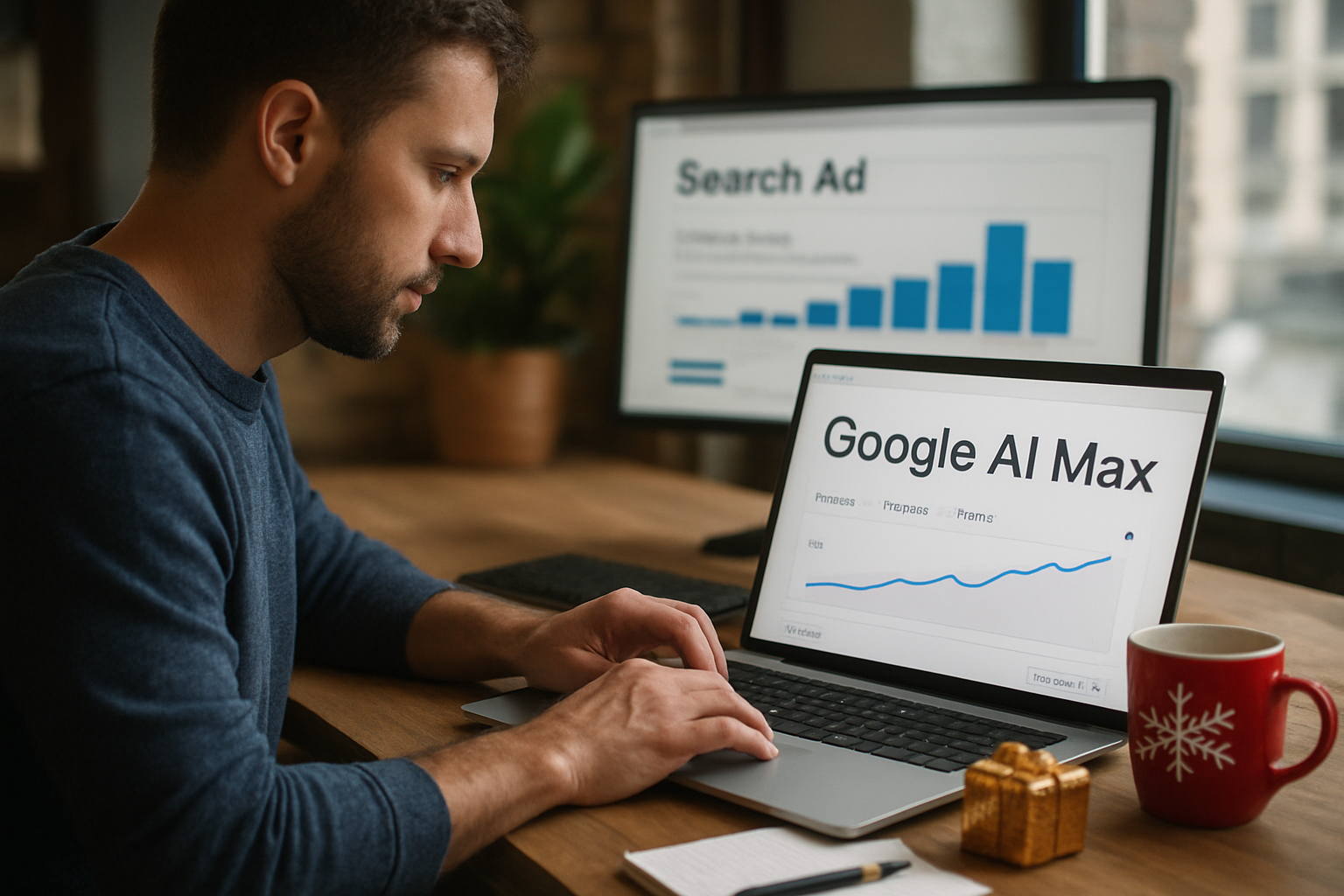
New testing, planning, and measurement features give small advertisers a way to compare budgets, protect brand and location controls, and forecast whether higher spend is likely to pay off before peak season.
Why this matters for small advertisers
For small businesses heading into the holiday rush, Google’s latest AI Max updates are less about new ad formats and more about avoiding expensive guesswork. Google says its new testing, planning, and measurement tools are meant to help marketers “boost ROI” ahead of the holiday season, and the most practical use case for smaller advertisers is to test Search changes before scaling spend.
The opportunity is straightforward: if you are about to raise budgets, change bidding targets, or expand Search campaigns, Google is now offering more ways to compare what happens before you commit more money. That matters when every wasted click hurts more during peak demand.
What Google actually added
According to Google’s Aug. 20, 2026 AI Max update, advertisers can now run a single A/B test method to compare different budgets and ROI targets across multiple Search campaigns. Google also added experiment support for brand and location controls, which gives businesses a way to keep guardrails in place while testing whether AI Max can improve performance.
Google says Performance Planner can now show how changes such as bidding or budget targets may affect existing performance, and it can apply suggested changes in one click after review. Google’s help documentation says Performance Planner is built to forecast monthly and quarterly performance, identify seasonal opportunities, and simulate how budget changes affect clicks, conversions, and CPA.
How a small business could use it before holiday demand spikes
The practical play is to test first, scale second. A local service business, ecommerce seller, or lead-generation advertiser can use AI Max experiments to compare a control campaign against a treatment campaign with a different budget or ROI target. If brand or location restrictions matter, Google’s new controls make it easier to keep those rules while still testing performance.
Then Performance Planner can help answer a more expensive question: if you raise spend now, are you likely to get more conversions, or just more costly traffic? Google says the planner can simulate budget changes and estimate their effect on clicks, conversions, and CPA, which is useful before holiday CPCs rise.
Measurement is the other half of the decision
Google’s Sep. 10 measurement update adds Data Manager integrations into Google Analytics and DV360, enhanced conversions in GA and DV360, a universal Data Manager API, built-in diagnostics, a new Data Strength Uplift metric, and Meridian/GeoX improvements for incrementality measurement. For small businesses, the point is not the feature list itself; it is better signal quality before bidding gets more expensive.
Google says advertisers connecting offline and app data to Data Manager see an average 26% increase in incremental ROAS, and enhanced conversions show an average 11% increase in Search conversions versus standard conversion imports, based on Google internal data. Those figures are Google’s own, but they reinforce the same practical message: cleaner conversion data can make automated bidding decisions more useful.
What to watch before you switch anything
Google’s support pages also show that these tools are evolving quickly. Performance Planner no longer supports Display or Video planning as of Mar. 9, 2026, and Google says bidding systems will change starting Aug. 17, 2026 for campaigns limited by budget using target-based strategies. Google also says it will not automatically adjust daily budgets or bid targets.
That means small businesses should treat these tools as decision aids, not autopilot. The safest approach is to test on a limited budget, verify conversion tracking, connect first-party data where possible, and watch for temporary performance swings when changing strategies.
For BizTipper readers, the opportunity is clear: use Google’s AI Max testing, planning, and measurement stack to decide where to spend before holiday demand spikes, instead of learning after the money is already gone.